Glory & Grace

Glory-and-Grace-2014-12Even when we do not think of God, we all depend upon Him every moment of every day. The more we become aware of Him, the more we experience freedom. When Isaiah met God in the temple, it changed the rest of his life. On that day, he heard the angels cry out,

“Holy, Holy, Holy is the LORD of hosts, the whole earth is full of His glory” (Isaiah 6:3)!

The whole earth is full of His glory! Yet tragically, most of the time, we don’t see it.

Go down the streets anywhere and observe the people. How many of them walk about
with stooped shoulders, dead eyes, and grim faces.

Yet right before their eyes, may lie a glorious sunrise or a lovely child. Overhead, graceful flocks of birds may head for unknown destinations, guided by instincts still little understood.

Every moment, we are surrounded by thousands of signs of a glorious God. But more often than not, we miss them because we are consumed by our own worries, doubts and frantic schedules! All too often, WE may be those grim-faced people on the streets!

Paul says, “Since creation, His invisible attributes, His eternal power and divine nature have been clearly seen…” In other words, HIS GLORY. But…

“Even though they knew God, they did not honor Him as God or give thanks.”

Yes, more often than we like to think, this appalling verdict claims us, as God’s children of grace—even now. We all have myopic vision and futile thoughts. Too often, talk of God’s glory seems to contradict our daily experience of mediocrity, sorrow and failure. But…

The Gospel of John tells us, “The Word became flesh and dwelt among us, and we saw HIS GLORY, glory as of the only begotten of the Father, full of grace and truth” (1:14).

His great glory is His grace. That grace and glory of God came to live among us through a young teenage girl giving birth to a Child in a manger. It ended on a cross. In Romans, Paul tells us that we, too, were crucified with Him. Three days later, we were also raised with Him, so that our life of mediocrity, sorrow and failure might become absorbed and transformed by His resurrection GLORY. He lives for all eternity, now and forever. So do we who trust in Him.

In short, through His birth in a manger, death on a cross and resurrection from a tomb, He has already given us the gift of His glory to experience now and forever. As Paul tells us, even in spite of ourselves, we can “reckon ourselves dead to [the kingdom of] sin and alive to [the kingdom of] God in Christ Jesus” (Romans 6:11). Yes, God’s glory is also His grace.

So the battle is already over, and the victory is already won. The prison doors have flown open. The shades are up, and the glorious light of God already shines upon us. Already, God tells us, “Get up! You are free! Walk out into all that I planned for you before I created the universe! It is yours now!” This grace is true glory and freedom!

The rest of the world still sees only prison cells around them, and they walk about with grim faces, awaiting their freedom. Let us better see the gracious glory of God for ourselves, that we may help them to see it–and to experience true freedom!

Tagged , , ,

Lydia and All of Us

Throughout the centuries, men have tended to regard women as inferior. This judgment upon women is a judgment upon God who made women and can only quench the Holy Spirit in men who make such judgments.

Lydia is a good example of God’s great work through a woman. Overnight, the history of Europe began to change because Lydia heard the voice of the Holy Spirit speak through Paul. She responded and became Europe’s first convert.

Because of her faithfulness to the message she heard, the gospel spread to those around her, like a stone whose ripples spread out over a pond.

Lydia serves as an example to both men and women of how the Holy Spirit can work in anyone to change the world in the name of Christ.

  1. God opened Lydia’s HEART to do a work of grace in her life. God alone ordained her time to come to Christ and to use her conversion as a means to ultimately change the direction of a whole continent and the rest of the world. Through her witness, her entire household believed and received baptism. Through her and her household, the church at Philippi was born. That church became a strong witness for the Lord and served as a model for future churches. All of this began with the conversion of one woman. There are no small people in the kingdom of God. We must open ourselves to all that God chooses to work through our lives.
  2. Lydia opened her HOME for God’s servants and fellow believers. Like Lydia, we all show our gratitude to God by the way we treat God’s servants and our brothers and sisters in Christ.
  3. Lydia offered her HANDS to minister to others. Lydia took Paul and Silas into her house to nurse their wounds from jail and beatings and help them recover. A helpful spirit is not just “woman’s work.” A helpful spirit is an effective witness for Christ in men and women alike. A helpful spirit is a spirit of salt and light that preserves and enlightens families, cultures and nations with the power of Christ.
  4. Lydia had a good HEAD for business and practical affairs. Lydia was a prosperous businesswoman. Lydia is a good example of a wealthy servant–one who regards all wealth and personal possessions as gifts from God to serve Him and others in need of His transformation.

Since Lydia’s generation, the Spirit of God has worked in the hearts of other women to do great and mighty things. Think of Amy Carmichael who ministered to girls caught in forced prostitution. She modeled ministries in India later founded by men.

Think of Monica, mother of a wayward youth named Augustine who became one of Christianity’s most influential theologians because of her prayers.

Think of Susannah Wesley, mother and faithful teacher to 19 children including John and Charles Wesley.

Think of Elizabeth Elliott, wife of martyred missionary, Jim Elliott, who took up her husband’s mantle and served as God’s instrument to change a savage culture for Christ.

As followers of Jesus Christ, we depend upon God’s Spirit. Let us all thank God for such boundless grace that works in so many ways. Let us especially make sure we accept all the grace He reveals through His chosen women.

Tagged , , , , , , , , ,

8 Ways to Walk in the Spirit

What is the secret to dealing with temptations and worldly desires?

Paul answers this simply: Walk in the Spirit, and you will not fulfill the desires of the flesh” (Galatians 5:16).

Sept blog - walk in the spirit copyWhat Paul is saying is: a person cannot walk in the Spirit and fulfill the lusts of the flesh at the same time. We will do either one or the other.

“Walking in the Spirit” means learning how to live out the life of God given to us when He gave us the Holy Spirit at our first moment of trust in Him.

The only One who has fully walked in the Spirit is Jesus Christ. The rest of us are much more inconsistent. Even well-known evangelist Billy Graham at 95 says that he regularly confesses his sins before God.

It is easy to worry about our failures, but it helps us to know that learning to walk in the Spirit is a lifelong process. There are things we can do to help that process along:

1. Know who you are. Make Jesus Christ and His sacrifice on the cross the source of your identity. Know that God chose you before He created the universe, so reckon yourself dead to sin and alive to God now. Know that God is your Father, that He has always been on your side, that He wants you to succeed. Peter was a wavering coward, but Jesus still called him “the rock.” What possibilities does Jesus foresee in you?

2. Let your spirit dominate. The desires of the world demand attention, but they soon pass away. Learn to see the bluster of the world for what it is. Learn to see God’s control of all things and act accordingly. This may take many trials and errors, but every time you succeed, you build a foundation for future success.

3. Think “kingdom thoughts.” Know that God’s kingdom ultimately triumphs. Learn to develop thought patterns that reflect God’s ways, concerns and goals.

4. Pray and listen. Develop prayer as a dialogue with God. Learn to listen as well as to speak.

5. Live harmoniously. Learn to live in peace with God and others. Avoid judging others through gossip, slander and bitterness. Someone has said, “You only love God as much as you love the persons you find hardest to love.”

6. Examine yourself. Let the Bible help you do this. Be honest with God and yourself. Stop hiding and rationalizing. Let God show you the “junk” in your life He wants removed.

7. Know your weaknesses. We all have them, so know them. Give those weaknesses to the Holy Spirit and seek His help during temptation and pressure. Don’t let your weaknesses and failures discourage you. Confess your sins daily. Remember—God is on your side.

8. Know your Helper. The Holy Spirit is your best friend and mentor, so learn to know and trust Him fully. Take all your troubles to Him.

The apostle Paul has good advice for all of us in this process of learning (and sometimes failing) to walk perfectly in the Spirit: “…forgetting what lies behind and reaching forward to what lies ahead, I press on toward the goal for the prize of the upward call of God in Christ Jesus” (Philippians 3:13, 14)

As we look forward with Christ, others who hunger for righteousness will notice, and they will want to know the truth that sets them free.

Some points taken from this article.

Divine Love Letter

Only the one who senses true love can fathom the real meaning of a love letter.

When a woman receives a letter from a man and senses his unmistakable devotion, respect and self-sacrifice for her welfare, she can hardly wait for the next one. She wants more than to know him but to commit her life to him.

How much more so the person who recognizes in the Bible a personal love letter from God.

To accurately interpret any document, we must understand the context in which it was written and the purpose the writer intended. The Bible comes to us from the context of the holy love and grace of God, perfect in every respect. This God has sacrificed and lavished more on His beloved than is beyond human understanding or possibility. Human love on this earth has a beginning and an end. Divine love for each of us has no beginning and no end.

photo 1To read and interpret the Bible in this context is to discover the Bible’s underlying meaning. In this context, even so-called “dead” books of the Bible, such as Leviticus, take on new life.


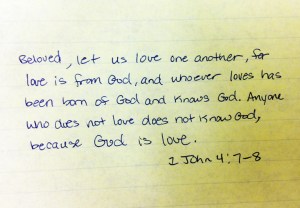
Just as the beloved sees in a love letter something special written directly to her, so we ought to read and interpret the Bible as a special letter to us. Then the Bible becomes irresistible. We eagerly open its pages and expect it to daily give us our personal, creative and renewing word of God meant for us now.

We will find the Bible is like no other love letter. Human passion, however sincere, possesses no power to perfectly fulfill its promise. The Bible not only expresses passion, but power to change our lives and circumstances. We experience its power to heal, set free, transform, change evil into good, turn ashes into beauty, change the destiny of the universe.

Those outside a love relationship often regard a love letter as little more than “sweet nothings.” In a similar manner, those without God do not see the Bible as personally written to them or anybody else. For them, the Bible is a hodge-podge of ancient and irrelevant stories and religious gibberish.

Even Christians can turn this divine Love Letter into less than what the Author intended. Too often, Christians regard the Bible as an impersonal book of stories, rules and moral standards. Too often, we read the Bible without seeing its application to our personal and present moment. We let details confuse its message. Even right theology can miss the love that shines through each page. This was the sin of the church in Ephesus (see Revelation 2).

The gospel takes deep root only as God’s people daily experience the holy love, grace and righteousness of God found in the Bible. On the night before His crucifixion, Jesus told His disciples, “Abide in my love” (John 15:9). From this basic interpretation of the Bible comes everything else.

Millions of people in places like India await a genuine love letter from God. They can hardly fathom that such a letter exists because of sin and evil in their lives and circumstances.

Only as we, the professed recipients of God’s love, live out the spirit and power of God’s Love Letter in our own lives will they believe that letter is also for them. Let us not disappoint them.

Globalization

In 2010, I was a delegate at the Lausanne Conference in Capetown, South Africa. That gathering of mission-minded Christians from around the world reflects the growing realization that the Great Commission requires global cooperation with other believers.

The Lausanne Conference is just one example of the growing influence of “globalization.” A conference speaker, Dr. Os Guinness, defined globalization as “a process by which human interconnectedness has reached global proportions.”

Globalization promises to revolutionize the human condition in a permanent and fundamental way as the invention of the wheel, printing press or automobile. Globalization is here to stay, and as Christians, we better come to terms with it.

GlobalizationThis process of globalization is driven by revolutionary developments of information technology. Through IT, we can create, multiply, expand, intensify and accelerate more human activities with more people than ever before.

This growing phenomenon has implications for all of us, and especially for the spread of the gospel to the remaining peoples of the world who do not yet have the Good News.

As Dr. Guinness told us at the Lausanne Conference, “Globalization is the greatest challenge and opportunity for the church since the apostles.”

The big question: Are we really ready for the challenges that globalization brings?

From my own observation, I think I am safe in saying that we are not ready, on a lot of levels.

But I am also safe in saying that globalization has not caught God by surprise. He knew it was coming, even 2,000 years ago, when He gave His Great Commission to His disciples. He knew about globalization long before anyone thought about it.

From the beginning, Jesus knew that He was giving His disciples a task way too big for any of them to handle. They were simple men in a world too complex and big for them. They weren’t ready. They were unqualified for the job He assigned to them.

And yet look what God has done through those twelve unqualified men and those who came after them! How did these unqualified men do so well? Perhaps most importantly, they realized how unqualified they really were.

Scripture tells us that before they set out on their mission, they waited upon God in the Upper Room until the Holy Spirit came upon them. Only with the coming of the Holy Spirit did they begin the process of taking the gospel “to Jerusalem, Samaria and the uttermost parts of the world.”

That simple strategy of the disciples must become our own. We must recognize our inadequacy for the task. We must recognize our slowness of heart, lack of faith, our tendency to let the standards of the world influence us. We must come to terms with the sins that so easily beset us. Indeed, the church is in dire need of a spiritual renewal such as never before.

Only with a new outpouring of the Holy Spirit will we make the challenges and opportunities of globalization count for Christ so that the gospel is preached to all peoples and touches people in every facet of their lives.

Are you waiting on God for the outpouring of the Holy Spirit, for yourself and for your church and nation?

Present Your Bodies a Living and Holy Sacrifice

In recent years, we have seen a growing interest in developing healthy and trim bodies, diets and lifestyles. To be frank, some of this is faddish, obsessive and self-centered, a futile attempt to frustrate the aging process and enjoy life before death claims us.

But a healthy lifestyle is essential if we do it for the right reasons. Indeed, seeking a healthy lifestyle is essential to living a godly life, preaching the gospel and winning the lost.

In simple words, the Apostle Paul tells us in Romans 12:1-2 the essential ingredients of a healthy lifestyle:

June Blog - healhty living photo copy“Therefore I urge you, brothers, by the mercies of God, to present your bodies a living and holy sacrifice, acceptable to God, which is your spiritual service of worship. And do not be conformed to this world, but be transformed by the renewing of your mind, so that you may prove what the will of God is, that which is good and acceptable and perfect.”

Pure and simple, a healthy lifestyle is treating our bodies as temples where God dwells and learning to think God’s thoughts after Him, so that our deeds proclaim God’s glory to others and that we might do what God planned for each of us before He created the world.

To be sure, none of us has mastered this very well. Too often, we are troubled with stress, high blood pressure, weight problems, overwork, poor diet, little sleep and exercise, obsessive and compulsive thoughts, addictive behaviors and distracted devotion times. Many heart attacks, strokes and other physical problems come simply because we don’t take care of ourselves. All of this keeps us from the full and creative life God intended.

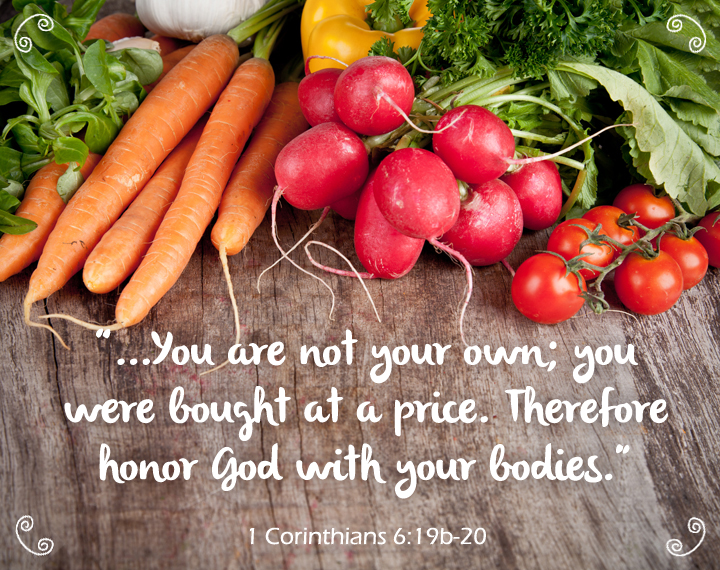
Too often, we get into unhealthy patterns of living because we act as if our body is ours when it is really the temple of the Holy Spirit (1 Corinthians 6:19-20). Many times, we live our lives with broken spirits and not with merry hearts. Too often, we live our lives for our own purposes rather than the Lord’s (Romans 14).

To live healthier lifestyles, we may first need to better learn how to trust the Lord with all our hearts (Proverbs 3:5-6). We may have to learn to better listen to God and focus upon His will rather than our own. (Psalm 16:11). We may have to learn how to become teachable like little children throughout our lives (Psalm 32:8).

We may still have to better understand how interested God is in the smallest details of our lives (Matthew 10:30). We may still need to discover God’s promises and trust them 100% (Psalm 1:1-3). We may yet have to learn how to live eternal life as a present reality (2 Corinthians 5:17). We may yet have to learn how to love His appearing (2 Timothy 4:8).

Even if we have been born with a “thorn in the flesh,” like the Apostle Paul, we can still learn these things and say, “I have fought the good fight, I have finished the course, I have kept the faith.”

That is truly healthy living. God help us all to learn these things well and live our lives to His glory and the advancement of His kingdom.

Only Increased Preaching of the Gospel

How should Christians deal with human trafficking in ways that glorify God, advance His kingdom and help victims?

Human trafficking is growing in India and America. It is a form of human bondage and slavery.

In the Apostle Paul’s time, the Roman Empire was a slave society. In the city of Rome alone, hundreds of thousands of men, women and children were trafficked as slaves.

In 61 AD, a Roman slave killed his master, Lucius Pedanius Secundus, Prefect of Rome, in protest of his condition. He was immediately arrested. The law of the day required that for this crime of one person, all the master’s slaves be put to death. In this case, it meant death for 400 innocent people.

The population of Rome rioted in the streets over this injustice. The Senate debated the issue and decided that the only way to control slaves was by fear. The law was enforced, but a large military guard lined Rome’s streets to stop the chaos as 400 innocents were led to their deaths.

The Apostle Paul, in a Roman jail about that time, surely knew all this when he wrote his letter to Philemon, a Christian brother. Philemon’s slave, Onesimus, had stolen goods from him and run away. Philemon had every legal right to have Onesimus executed like those 400 slaves.

But the escaped slave, Onesimus, wound up with Paul and became a Christian. He was a new man in Christ. Now, he wanted to make restitution. Paul intervened on his behalf.

Paul knew that his words would set a precedent for future Christians. If he just condemned slavery, Roman masters without Christ would ignore him. Strong words may have incited powerless slaves to rebel and be killed for it as were the slaves of Lucius Pedanius Secundus.

Under inspiration by the Holy Spirit, he urged Philemon to regard Onesimus, no longer as a slave but as a fellow brother. He appealed to the transforming power of the gospel in both their lives. We can be sure that when Onesimus returned to Philemon, he did not return to bondage but as an equal in ministry with his former master. What an example of gospel transformation!

Paul knew that the most effective way to social change was through Christian example and changed hearts. Only increased preaching of the gospel would bring these to pass in the society
at large.

Paul knew and taught that in Christ, there is no slave or free. We are all one in Him. Christ is no respecter of class or caste. He does not regard one person as intrinsically better than anyone else. All castes and classes come within equal reach and power of the gospel.

Paul’s approach toward slavery in the Roman Empire models for us how we should handle human trafficking issues today. However well-meaning, legislation, admonitions and force will not change hearts of those who exploit others. Calls to rebel mean nothing to victims too powerless to succeed.

Rather, we must keep preaching the gospel to all. We must become better aware of the human trafficking in our midst. We must serve as examples, offering help to those who have suffered from trafficking or are in danger of suffering.

Already, thousands of Christians in India are helping the helpless in this way. This Christian witness touches more people than we know, gradually—and peacefully—laying the foundation for permanent social change.

Soldiers of the Commander in Chief

In the past month, we have seen graduations at five of our training institutions in India. Our graduates will go out as evangelists and church planters to new and challenging places w

here the gospel has never gone before.

Mizoram Bible College GraduationAt India Bible College and Seminary, the graduates were enjoined to live their lives and conduct their ministries as “faithful men” who entrust the truths of the gospel “to faithful men who will be able to teach others also” (2 Timothy 2:2).

The Apostle Paul’s picture of a faithful man is the good Christian soldier. A good soldier sacrifices himself for the cause. He takes risks and even lays down his life. He serves others. He opens himself to suffering and even death. He seeks the good of others at risk to himself. He experiences temptations to indulge in creature comforts, but puts these things aside to serve the long-term good of all.

A good Christian soldier follows the orders of his commander in chief. He has a team spirit. He has a deep passion for victory. He hurls himself into battle and conquers his fear. His heart does not fail him when the battle becomes fierce. The word “surrender” is not in his vocabulary. He does not compromise with a deadly enemy.

An effective soldier depends upon a wise and brilliant commander. When a soldier first enters the military, he is unfit and undisciplined for the task before him. A good commander understands this and will make sure he develops qualities needed for intense battle. A good commander plans the most effective strategy for decisive victory and will insure that those under his command will have all the resources they need to win.

A good commander knows how to win the loyalty of his soldiers. He gives his troops reason to risk their lives under his orders. He demonstrates that he understands their mission and the severe demands placed upon them. He knows how to communicate concern, encouragement and vision for the cause. He instills confidence in the final victory, though the war may seem long and even endless.

There is no better Commander than Jesus Christ. When He calls us, we can be sure we are on the winning side. Though we may not find ourselves qualified to be His soldiers, He patiently qualifies us for the task He has given us.

A human army may use up thousands of nameless lives, but as Charles Spurgeon has said, “Our glorious Leader never squanders the lives of His soldiers.” Our Commander notes every sacrifice made, every pain endured for the sake of the gospel.

The life of a soldier is hard, but the qualities of a soldier are necessary for all of us who profess commitment to our Commander-in-Chief, Jesus Christ.

Pray for the graduates from our training institutions who have just entered into the spiritual warfare for India. May God grant each of us, our families and churches the qualities of faithful Christian soldiers as we take the gospel into the world where He has placed us.

The Finger of God

All of us need a special healing touch of God upon our lives that renews as well as purges out what is unnecessary or harmful.

The ancient Egyptians of Moses’ day referred to this as “the finger of God.” This is a colorful term that refers to God’s direct and miraculous intervention in human affairs. The Egyptians were referring to how God miraculously freed the Israelites through the judgment of plagues upon Egypt. At the same time, the finger of God brought freedom to His chosen people.

We also see “the finger of God” in judgment upon the corrupt Babylonian monarch, Belshazzar, as a large hand appeared and spelled out his imminent doom.

But “the finger of God” appears also in God’s acts of grace and mercy as He writes the Ten Commandments for His chosen people, Israel. Later, Jesus frees people from the power of demons by “the finger of God” (Luke 11:20).

Today, we experience “the finger of God” most notably through the work of the Holy Spirit. Before He departed His earthly ministry, Jesus promised His disciples—and us—the privilege and blessing of the Holy Spirit in our lives. The Holy Spirit—God’s very presence—is our guarantee all that He intends to miraculously work in us.

The Holy Spirit is more than a force or power. The Holy Spirit is God Himself dwelling in and through us. The Holy Spirit is the same One who created the heavens and the earth, the galaxies and stars, and all the millions of species of plants and animals. None of us has fully grasped or experienced the full power of the Holy Spirit that is our awesome privilege.

The Holy Spirit guarantees our inheritance in God’s kingdom. The Holy Spirit is our constant companion. The Holy Spirit does battle for us and gives us protection and victory. The Holy Spirit sets up divine appointments for us, guides us into truth, and gives us heavenly power. The Holy Spirit enables us to display the life of God to a world who does not believe in God.

“The finger of God” is still at work today:Image
• The finger invites us and others to become a part of His kingdom and join Him in His work.
• The finger writes His law on our hearts.
• The finger grips us for all eternity.
• The finger points us to the truth. We can depend upon the Holy Spirit to give us wisdom in life’s most challenging circumstances.
• The finger works. The Holy Spirit works in us, and when we give Him permission, He enables us to live and work in ways that display the glory and character of God to the world around us.

Through the Holy Spirit, we may become agents of the Holy Spirit, inviting others into His kingdom. We may write things that move others to respond to Christ. We may faithfully seek out those whom God wants to seal for His kingdom. We may point the way for others to receive Christ. We may do the work that God has given to us, empowered by His might.

Let each of us seek to become better acquainted with the ministry of the Holy Spirit in our lives that we may better minister to others who await Him.

Tagged , , , , , , ,

Identifying a True Prophet of God

The gospel finds its place in men, women and children to the extent that the Holy Spirit enlivens and plants His written Word in their hearts. He does this in a number of ways. One of those ways is the prophetic word.

True prophecy is the Word of God coming through a human messenger. This is both its potential strength and weakness. Some people say that we should dispense with prophecy because of the potential for false prophecy. But this is like saying we should stop eating because of so many foods that prevent good health.
Even as we learn to distinguish nourishing foods from less nourishing foods, we can learn to discern true prophecy from false, so that prophecy will become an enormous blessing for all.

Wolf in sheeps clothingThe truth is, we all need prophetic words. True prophecy sustains and nurtures us. True prophecy gives life, encouragement, warns us of danger, puts us on the right path, and dispels the lies of Satan. True prophecy takes us beyond our own thoughts, renews our minds and transforms our lives.

The prophetic word is prompted by the Spirit of God and is rooted in true revelation (1 Corinthians 14:30). It becomes fallible if the prophet has faulty perceptions and interpretations. But prophecy is one of those gifts that can improve with time and practice as the prophet grows in his walk with God Therefore, we should not despise prophecy, otherwise we stifle the Holy Spirit (1 Thessalonians 5:19-20).

What are the marks of a true prophetic word from God? How can we distinguish true prophecy from false?

First of all, true prophecy glorifies God and Jesus Christ as the Way, Truth and the Life. True prophecy never contradicts scripture. It draws us into closer relationship with the God of the Bible. It never rationalizes with sin. It encourages greater trust in God and His ways. It promotes unity and love in the body of Christ. It humbles us before God and before one another. It edifies, encourages and brings hope. All these things are present with true prophecy.

God wants to communicate with His children. What a miracle that He chooses to do so through flawed people! I have personally benefited from prophetic words, and I know from experience the blessing that true prophecy can be.

At the same time, I know of those who masquerade as prophets for the sake of personal gain. Such people can do great harm as they spread lies in the name of God for the sake of recognition and attention. Beware the so-called “prophet of God” who is popular with the masses!

The truth is, a true prophet will not often be loved by others because he loves God more than life itself. A true prophet does not seek popularity. His word will oppose the world, so the world will hate him. The only people who love the true prophet are those who hunger after God and His truth. When they hear the truth coming through God’s human messenger, they are set free.

We must fulfill the Great Commission by every means the Holy Spirit gives to us. True prophecy expands the body of Christ as it applies the written Word to life and ministry. The completion of the Great Commission depends upon its wise use among the people of God and those whose hearts He is preparing to receive His truth. May we seek this gift and use it wisely for His glory.