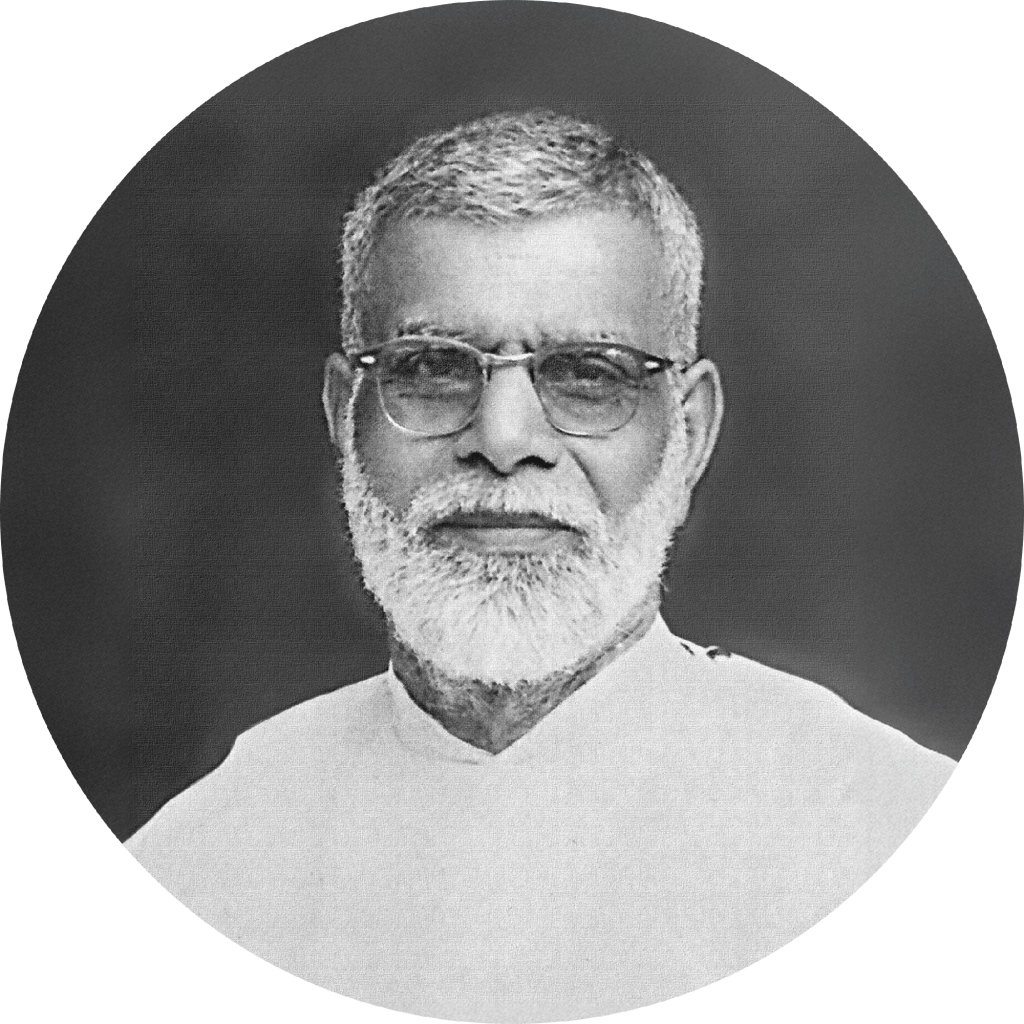
It is a fact that God uses men and women to accomplish His purposes. This is the pattern throughout the scriptures and church history. Some people think that this simply “happens,” or that some are “special,” but others are not.
This is not so. Rather, there are specific reasons why God uses some but not others, and these reasons boil down to the choices that we make, often early in life. Our choices determine whether we become good clay in the Potter’s hands.
As an example of this, I mention my own paternal grandfather, Pastor K.E. Abraham.
Some of my readers know his name, life and history. Church historians and members of other denominations recognize him as the founder and chief architect of the Indian Pentecostal Church. To those who want to learn more about his life and ministry, I refer them to numerous books and seminary dissertations, a biography, and his own autobiography.
All those who knew him well and have studied Pastor K.E. Abraham’s life agree that he was indeed a man of God.
I want to suggest some reasons why God used K.E. Abraham. As we understand these reasons, we can better understand how God can use you and me more effectively and fruitfully. When he died in December 1974, I was a very young man. But as a grandson who knew him intimately, I have learned not only why God used K.E. Abraham but also why He uses anybody willing for God to use them.
The writer of Hebrews tells us, “Remember those who led you, who spoke the word of God to you; and considering the result of their conduct, imitate their faith. Jesus Christ is the same yesterday and today, yes and forever” (Hebrews 13:7-8).
God shapes a leader over a lifetime. Some leaders finish well, others do not. A recent study of biblical leaders by a well-known Bible scholar indicates that only one of three leaders finished well. We all want to finish well. How do we do that? What are the ingredients of a well-lived life, used effectively by God? What can we learn from Pastor K.E. Abraham that we might experience the life that God uses for His glory and for the blessing of others?
RECOGNITION OF THE IMPORTANCE OF THE HOLY SPIRIT
From the beginning, K.E. Abraham knew that he could never live an effective Christian life apart from the power of the Holy Spirit. Christian life is not a matter of self-effort, religious temperament, or anything else. First and foremost, it is the life of the Holy Spirit working through him in every facet of life. He recognized early that Christianity is a supernatural power.
AN UNQUENCHABLE DESIRE TO LIVE BY THE POWER OF THE HOLY SPIRIT
A person can recognize the importance of the Holy Spirit without a desire for the power of the Holy Spirit. K.E. Abraham allowed that desire to consume his days and nights. In his prayers, he searched for the infilling of the Holy Spirit. He spent seven years diligently studying the Scriptures to understand the importance of the Holy Spirit. He even walked 100 miles from his hometown to spend time with a godly man, seeking to be immersed in the Spirit.
A STRONG SENSE OF CONVICTION
K.E. Abraham never wavered in his desire to seek God’s truth or do His will. Knowing that God is faithful, K.E. Abraham was willing to pay the price, whatever the cost. When he took a stand, he stood by principle regardless of where it led. That is the sign of a leader, in contrast to a politician whose decision is determined by the polls.
A desire for truth is not always understood by others, especially those who don’t seek it. K.E. Abraham found himself in the minority. Others misunderstood him. He endured harsh criticism and insults. His Syrian Orthodox church excommunicated and reviled him, but he passionately continued to search for the truth, knowing that God would vindicate him.
For six months, these events forced him to worship God in isolation. But when a cobra bit one of his neighbors, God worked through him to bring healing and demonstrate the truth that God revealed to him. After witnessing that healing, the priest who had expelled him six months ago asked K.E. Abraham to preach at the church the following Sunday.
FULLY SURRENDERED, TOTALLY FOCUSED
K.E. Abraham wanted nothing to distract him from God’s call over his life. He knew that a focused life is like a laser beam. He was a teacher, but he surrendered his job, his future, and everything he had to whatever God would do in his life. He gave all to God. He did not believe he was perfect, but he knew what was best, the Lord Jesus Christ and His work. He treasured it above all else and was willing to give whatever he had to get it. As Henry Varley once said, “The world has yet to see what God will do with a man who is totally dedicated to him.” Like Dwight L. Moody before him, K.E. Abraham said, “I will be that man.”
A SIMPLE LIFE
K.E. Abraham’s single-mindedness kept him from distractions. He travelled light literally and metaphorically, he did not clutter his mind, he did not give himself over to worry, he placed no value upon possessions apart from their relationship to the kingdom of God. That freed his spirit so that people could become more important to him than possessions. His simplicity was a conscious choice, a discipline he followed. But his simplicity was not merely a philosophy of renunciation. People knew him as a man of joy. He always dressed neatly, neither shabby nor ostentatious. He found himself at home among rich and poor alike because their possessions meant nothing to him. With no need to impress people with material things, he impressed people instead with his life.
A STUDENT OF GOD’S WORD
From the beginning, K.E. Abraham recognized that for God to use him, he must have the mind of Christ. This meant that he must hide the Word of God in his heart and meditate on it constantly. By the time he was only eight or nine, he had read the entire Bible several times. A priest discovered that not a single page of this child’s Bible was unmarked. As a young boy, he knelt, prayed, and studied the Word. Only this foundation made possible the unforgettable sermons that moved so many people or trained the many outstanding teachers who followed him. This emphasis kept the Indian Pentecostal Church balanced and free from extremes.
A MAN OF PRAYER
A person who prays knows his strength comes from God. God uses the praying person most effectively for His purposes. K.E. Abraham knew how to spend days in fasting and prayer. Even as a young boy, he began to develop a prayer habit. He took all manner of things to God. He closed himself off from others and from food to prevent any distractions. When he married a couple, he spent a day in prayer for them. He learned to trust God entirely for his needs, not even telling family members, so he could watch the Lord consistently bless.
CONSISTENT COMMITMENT TO GODLY VISION
Out of K.E. Abraham’s commitment to God’s truth through the Holy Spirit, the Word, and prayer emerged a godly vision for the World. This godly vision gave him a lifelong task from which he did not waver. As he depended upon God for strength, God gave him the strength to remain faithful in his task. K.E. Abraham’s vision was to reproduce people for the ministry through personal mentoring, and through them build dynamic churches. Because of his commitment to this godly vision, he produced people with a similar vision, willing to die if necessary for its fulfillment.
REGARD FOR MONEY AS A TOOL ONLY
As a person dependent upon God for all his needs, K.E. Abraham did not let the love of money or material gain consume him. He saw money as a tool to further God’s kingdom, not the dominant goal of a person’s life. He gave generously and with compassion to those in need. When he died, his account showed a balance of only 5 rupees, the minimum balance needed to maintain a bank account.
GREAT SENSE OF HUMOR
As a person dependent upon God through the power of the Holy Spirit, the Word of God, and prayer, K.E. Abraham was at peace with God and himself. This gave him the freedom to smile at life. It also provided apt humorous illustrations for talks and sermons. He had a remarkable sense of humor and a playful spirit that attracted him to children and grandchildren.
A HUMBLE AND NATURAL SPIRIT
As he came before the Lord, K.E. Abraham met him in different ways that changed his life. Recognizing his dependence upon God, he put aside dependence upon his own strength, social class or his own spirituality. Therefore those who met him recognized genuine humility. He put on no spiritual airs. Nor did he adopt artificial means to appear either richer or poorer than others to elicit sympathy or respect. He did not dress either rich or poor. He did not put himself above or below others whom he knew that God loved as himself. He discouraged all artificiality in others.
AN ABILITY TO SEE VALUE IN EVERY PERSON
K.E. Abraham saw God at work in all people regardless of age, class or caste. He realized that God does not set up barriers to separate us from one another. Where others made distinctions, K.E. Abraham saw people as equals to himself, as potential partners in ministry and fellowship. He instilled in people a sense of dignity. Therefore, he could influence multitudes of people from different walks of life.
A TRAINER OF PEOPLE
As K.E. Abraham depended upon God and His Word, he recognized Jesus Christ’s calling upon him to teach people to do the same. Because he could value all persons regardless of background, he developed an ability to mentor and train others from every level of life to positions of leadership. He recognized the potential in all kinds of people, regardless of their background. As a result, he prepared thousands of leaders and helped found hundreds of churches. Every person was always a potential person for him to help, teach, and develop God-given abilities. Wherever he went, he took someone along to encourage them, to give them a sense of belonging and significance. In the end, many of his assistants became great leaders who made important contributions to the Indian Pentecostal church and the cause of Jesus Christ in India. K.E. Abraham’s desire for the church and those he trained was for them to remain grounded in the Word and balanced without extremes.
A PRACTICAL SPIRIT
K.E. Abraham saw God work in the lives of people in practical ways. This became his goal as well. He was a detail-oriented man who knew how to organize. We see this in the way he started schools for disenfranchised people. In his day, only the wealthy and high-caste people had a place in Indian society, while the poor and powerless had little chance.
K.E. Abraham provided free education to hundreds of lower classes to uplift them. His home became a shelter and place for training. He and his wife raised and taught orphans as if they were their own children. Also he was not satisfied to teach, but to go out to different places and personally establish churches.
Like all of us K.E. Abraham was a sinner saved by grace. There was nothing special about his background, but with God’s help, he made the right choices. God desires to work through each of us, even as He worked through K.E. Abraham, to do something significant for His Kingdom.
K.E. Abraham began, as we all must, at the foot of the cross. What separated K.E. Abraham from others was that he remained at the foot of the cross.
May we learn from his life that we may also become men and women serving God.


 From the Desk of Valson Abraham