
Tag Archives: discipleship

What Made This Church So Great?

If the conversion and Holy Spirit filling of the Samaritans, the Ethiopian eunuch and the Roman centurion Cornelius seemed radical to Jewish believers, what happened at Antioch must have gone off the charts.

The three people mentioned above were considered Gentiles, but they had at least some connection to the Jewish traditions. The people of Antioch were total pagans in just about every way imaginable, and then some. Yet in Acts 11, Luke portrays a fellowship of Jesus followers that has become a model for us in our own day.

Antioch became the gospel gateway to the rest of the Gentile world, the missionary headquarters leading to Europe, the rest of the Roman Empire, and ultimately, to us today. In Antioch, Jesus followers first became known as “Christians,” a term that once had a meaning far beyond the established religious groups we know today. What makes the Antioch church so great?

No one knows who founded the Antioch church—probably an unknown lay person. Whoever it was, the church also had supernatural roots. “The hand of the Lord was upon them,” Luke records. What a remarkable description! They depended upon the power of God, not their own knowledge and ingenuity. They heard the voice of God and saw Him work miracles in their midst. Programs were less important than people and the pleasure of God’s company.

As a result, record numbers of people from pagan backgrounds were turning to Christ from every background. They hungered for fellowship with God and with one another. They became involved in serious and effective prayer. They heard God speak to them through the Word. They had a Great Commission vision for the world. Deep understanding and application of the Word was vital to them.

From the Antioch church Paul launched his great missionary journeys that ultimately spread the gospel throughout the Roman Empire. Many other lesser known but powerful missions to the world had their beginnings at Antioch because the people there believed in self-multiplication.

Personal and corporate discipleship was the rule. Continuous spiritual growth and maturity was the goal. These people in the Antioch church were not rural hillbillies but sophisticated and cosmopolitan men, women and children from the third largest urban center in the Roman Empire.

Another unprecedented feature: Jewish and Gentile believers fellowshipped with one another. In today’s culture, that would be like Brahmans eating with Dalits, or whites hanging out with Black Lives Matter folks, or hippie-types enjoying fellowship with corporate executives. Such phenomena are “God things,” impossible to reproduce apart from a move of the Holy Spirit.

How many of our own churches today resemble the church in Antioch? As Henry Blackaby has said, “We have become satisfied today to live without the manifest presence of God.”

In spite of Bible resources unavailable to any previous generation, few church members today open their Bibles or pray. Few church members demonstrate any power of the Holy Spirit. Few church members have any vision for the world. Few churches are little more than religious social clubs. It is no wonder that the world as a whole considers the church powerless, useless and irrelevant.

Pray for revival and renaissance in the church. Pray that every fellowship returns to the Antioch model. Only then will we see our world change.

Tagged , , , , , , , , , , ,

True or False: Teachers

Blackboard with chalkA man looks at a sore on his neck that does not heal. He worries—is it cancer? Someone tells him, “Go to a doctor you feel comfortable with.”
The man decides he most wants a doctor who will tell him what he wants to hear. The medical practitioner he contacts is a very pleasant man with an impressive looking diploma. He assures the man he does not have cancer. He covers the sore with a bandage so the man doesn’t see it, and says, “Don’t worry.” Elated, the man goes home. However…

Six months later, the man dies of an aggressive and painful cancer that spread throughout his body. The doctor who gave him the “good news” is a charlatan. If the man had gone to a real doctor, he would have heard unpleasant news. He would have faced surgery, but he would also have lived a normal and useful life.

In spiritual matters, this same kind of foolishness happens repeatedly when we seek our teachers in false messiahs who tell us only what we want to hear.

The Bible portrays Jesus as the Great Physician. He tells us uncomfortable things. We don’t like to hear we are all sinners before a holy God, on our way to hell. We don’t like to hear we have terminal cancer of the spirit and only Jesus Christ, the Great Physician, can remove it.

Like surgery, Jesus’ crucifixion for our sins seems too bloody, ugly and primitive. We know we need help, but we seek our help in people who claim to be divine, even Jesus Himself, who tell us the easy way to the good life that fits our preconceptions.

Jesus Himself warns us about the dangers of following those who promote a different gospel from the one He taught—a “gospel” that leaves out sin, the cross and repentance, judgment and hell. He warns us about people who preach God’s love but not His holiness, His forgiveness but not His hatred of sin and the penalty for sin.

Jesus warns us that some false teachers may awe us with great miracles. But if they deny the gospel of the cross, Jesus says, “Stay away from them.”

How will we know when the real Christ appears? We will know by the manner of His second appearing which He makes very clear in Matthew 24:27: “For just as the lightning comes from the east and flashes even to the west, so will the coming of the Son of Man be.”

He will come “in the twinkling of an eye.” He will appear in glory, with myriads of glorified men, women and children from every time and place. His Second Coming will surpass all power to imagine or describe. (1 Corinthians 15:52; 1 Thessalonians 4:16-17; Revelation 1:7; 6:15-17; 19:16). No other so-called “christ” can match it.

Those who undergo the surgery of the gospel will welcome the Second Coming of Jesus Christ. It will come as a terror to those who refused His spiritual surgery. The Second Coming dwarfs all other so-called “christs” and reveals them as fakes.

How vital for us to know our Bibles, both Old Testament and New Testament, to find the true Jesus. The more we know the “real thing,” the easier for us to spot the counterfeits.

Let us tell others about Him, that they may also stand before Him in joy and gladness.

Tagged , , , , , , , ,

The First Mission Field

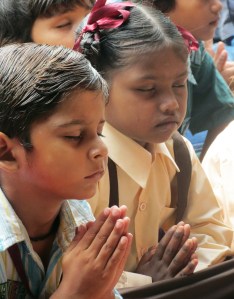
2017-03-slum-school-children-prayerOur children are our first mission field.

We live in a turbulent world inhabited by troubled youth and children, alienated from their families and society. Apart from a dramatic intervention by God, we face a troubled future whenever such troubled youth grow up, become parents themselves and take their places in seats of government, business, education, the arts, media and communication. How we raise our children today, influences our society for generations to come.

These things do not “just happen.” Two thousand years ago, the apostle Paul identified a major cause for an alienated generation when he wrote, “Fathers, do not provoke your children to anger, but bring them up in the discipline and instruction of the Lord” (Ephesians 6:4).

Too many parents stimulate rebellious spirits in their children when they resort to harsh discipline or fail to discipline them at all. Such extremes never work. What is needed is right discipline.

The key to right discipline is for parents to first discipline themselves, to submit themselves to their heavenly Father. Parents submitted to God know their children are not their personal possessions to treat as they please, but gifts of God. Parents are not to use children for their own purposes and ambitions, but to patiently help them to develop the unique personalities God gave each of them.

Like us, our children are born in sin. We depend upon God’s mercy and grace in our own lives, and we must treat our own children’s shortcomings with mercy and grace. Discipline is necessary, but to humiliate a child or inflict physical, verbal or emotional abuse have no place in a Christian home.

Paul tells us to raise our children “in the discipline and instruction of the Lord.” This means parents must learn to sacrifice their own interests to bring their children into emotional and spiritual maturity by instruction and example. Fathers and mothers must spend less time at the office or other activities to accomplish this God-given mission. Their own children are always their first priority.

Trying to force religion down their children’s throats or coerce a “decision for Christ” is never right. Going to church, Sunday school and youth group are good, but even better, children should see in their parents consistent character, integrity, and kindness that win their respect and motivate them to become like their parents.

They should see in their parents a worldview and lifestyle that sets them apart from parents of neighbors and friends. They should understand from their parents that this difference comes because of God’s gospel of grace in their lives.

Children should hear regularly from their parents how God has changed their lives, answered their prayers, and been faithful. Children should see in their parents the joy of the Lord, and know their parents pray for them every day.

Children should see and hear their parents read their Bibles and pray for those in need. They should hear their parents apply the scriptures to their lives, work and family. They should see their parents take a vital interest in those who still live in darkness without the gospel.

Yes, our children and grandchildren are our first mission field. If we have done our job right, our children will more likely become God’s ambassadors to their own children and a needy world around them.

Tagged , , , , , , , , , ,

Your Life, His Grace

In the Greek New Testament, the word for “witness” is also the root word for “martyr.” When Jesus tells His disciples, “You shall be my witnesses…,” He is also saying, “You will lay down your lives for My sake.”

This does not mean that we must seek martyrdom to become a “witness” for Christ. But it requires that we count the cost of discipleship. We must see ourselves as soldiers for Christ. When a new recruit takes his oath of loyalty, he gives his superiors the right to send him anywhere, even into battles that require great risk to his life, from which he may not return.

A-bigger-lifeTo become a “witness” for Christ means that we serve a life bigger than this earthly life. The circumstances of our lives are short and uncertain. There are other things better and eternal, centered on Christ. A true “witness,” like Jesus, has compassion upon people and a world that wander like sheep without a shepherd. Whether in life or death, true witnesses trust Jesus to provide everything they need, to go wherever He says to go.

Jesus warns His “witnesses” that He may assign them to take the gospel as “sheep to wolves.” Many will gladly accept the Good News, but others will hate the “witness,” claim that he is destroying society and seek to defame him or her.

Like Jesus, witnesses may also have to stand before the authorities in trial for their faith. But their suffering will further the gospel, and the Holy Spirit will give them the words to say at the right time.

We are to become Christ’s witnesses with the perspective of Christ’s own suffering and of His Second Coming. We are to know that whatever suffering we face will bring glory to God, a great reward in heaven and ultimate judgment for those who persecute us. We are to know that even if we lose our lives, human power over us ends at death, but God’s power is eternal.

Grace is costly, Dietrich Bonhoeffer reminds us. The gift is free, but it costs our lives. Beware of “cheap grace,” he warns, “the grace that we [not God] bestow on ourselves…forgiveness without repentance…baptism without discipline, communion without confession.”

“Costly grace,” he goes on, “costs a man his life, and it is grace because it gives a man the only true life.”

Dietrich Bonhoeffer knew what he was talking about. God called him as a witness to serve Him in Nazi Germany—a place unfriendly to the gospel. He became a leader of the Confessing Church when other German churches were giving in to Hitler. His friends wanted to save him by bringing him to America, but after a few months, Bonhoeffer knew he must return to the place God called him.

Bonhoeffer indeed paid with his life, but he became the ultimate winner. Days after his death, Hitler went down to defeat—and suicide. Bonhoeffer’s witness continues throughout the world in his writings and his example of commitment to Jesus Christ.

This month, as we celebrate Christ’s costly sacrifice and His triumphant resurrection, may each of us also count the cost of discipleship and commit ourselves to effective witness however and wherever Christ calls us.

Tagged , , , , , , ,